
Posts

Canva or InDesign? The Follow-Up Report

4 Min.

Is Adobe InDesign even necessary anymore, or is Canva sufficient for professional design projects? Our workshop “Adobe Meets Canva—Which License Do I Still Need?.” The answer—unsurprisingly—turned out to be more nuanced than many had expected.

What was planned as a traditional technical presentation quickly evolved into an open exchange of experiences among professional designers, marketing managers, Canva users, and accessibility experts. It was precisely this mix that made the afternoon particularly exciting: different perspectives came together, experiences were shared, and many existing assumptions were challenged.

Affinity delivers the biggest surprise

One of the highlights of the workshop was the integration of Affinity into Canva. Many participants were unaware that Canva had acquired the entire Affinity suite and that it can now be used at no additional cost as part of a Canva subscription.

This suddenly gives users access to a professional tool for vector graphics, image editing, and layout that significantly expands the previous limits of Canva. For many participants, this was the most surprising insight of the entire workshop.

Canva Excels in Collaboration and Speed

There was a particularly intense discussion about the possibilities for cooperation.

Using real-world client projects as examples, we demonstrated how multiple people—designers, copywriters, photographers, marketing professionals, and even clients—can work on a document at the same time. This approach offers enormous time savings, particularly when working on parish newsletters, annual reports, or newsletters.

The case studies clearly showed:

  • Several people are working on the same document at the same time
  • significantly shorter decision-making processes
  • fewer rounds of revisions
  • greater sense of ownership among all project participants
  • On-time print submissions

At the same time, it became clear that collaboration only works with clearly defined roles and a final quality control check.

Want to dive even deeper? Then mark September 8, 2026, on your calendar now.

In “Adobe Meets Canva – Part 2,” we’ll show you how both programs work together seamlessly in everyday business—from professional workflows and AI support to corporate design and efficient teamwork. Click here to register: Adobe Meets Canva – Part 2

Typography remains Adobe InDesign’s forte

While Canva excels in terms of speed, Adobe InDesign remains the gold standard for sophisticated typography. Professional typesetting projects requiring precise spacing, clean justified text, automatic hyphenation, or complex typographic rules can still only be reliably executed using InDesign.

The participants therefore quickly agreed: Anyone who regularly designs magazines, books, or high-quality printed materials will continue to find InDesign indispensable. Another focus of the workshop was comparing traditional layout functions.

Among other things, the following topics were discussed:

  • Sample Pages
  • automatic page numbers
  • Text concatenations
  • Double-page spreads
  • Tables of Contents
  • Automated layout processes

Although there are now numerous workarounds available within Canva—such as templates, brand kits, or AI-powered PDF imports—Canva still does not match the full range of features offered by Adobe InDesign.

Print quality is impressive in Canva, too

Another commonly discussed misconception has also been debunked: Canva now generates print-ready PDFs that include bleed margins and CMYK output. While not all color profiles are available, practical experience over the past few years has shown that Canva can produce very good print results—especially in digital printing.

Nevertheless, the panel’s recommendation was clear: Before undertaking complex print projects, color management should always be coordinated with the respective printing company.

During the discussion, one topic almost naturally emerged as the focus of a potential follow-up event: accessibility. Several experts in this field discussed the possibilities and limitations of both programs.

While Canva already offers basic features such as alternative text and decorative labels, both Canva and Adobe still have significant room for improvement when it comes to creating fully accessible PDF or HTML documents. This is precisely where many participants would like to see an in-depth workshop with concrete, practical examples.

Canva or Adobe? The answer is: It depends.

The most important insight gained that afternoon was that there is no clear winner.

Canva excels in any situation where speed, collaboration, ease of use, and cost-effective workflows are required. Adobe InDesign, on the other hand, remains the top choice when the highest standards are required for typography, complex layouts, or automated print production. Today, these two tools complement each other far more than many people might initially assume.

We would like to extend our sincere thanks to all participants for the engaging discussions, the numerous real-world examples, and the open exchange of experiences.

The strong response shows us that this topic is currently on the minds of many companies. That is why we are continuing the series. There was particularly high demand for in-depth workshops on accessibility, Affinity, and AI-powered design workflows.

We’re already looking forward to the next event and continuing our dialogue with you.

Curious now?
Our contact persons will be happy to help:

Matthias Brinkmann
+49 911 47494949
brinkmann@twobe.de
LinkedIn

When inquiries suddenly stop coming in: Why active sales are more important now than ever before

3 Min.

Many companies are familiar with this situation: for years, business almost ran itself. Demand was high, customers came through recommendations, existing networks or long-standing market positions. Sales often meant one thing above all: processing incoming inquiries, preparing offers and handling projects.

But what happens when market conditions change?

The market has changed – and now?

Rising costs, economic uncertainty, reluctance to invest and changing customer requirements are currently causing a noticeable shift in framework conditions in many sectors. Projects are being postponed, budgets cut and decisions delayed much longer than just a few years ago. Suddenly there are no inquiries, the pipeline is getting emptier, capacity utilization is falling and it is precisely at this point that it becomes clear how dependent many companies were on a market that had provided a tailwind for years.

What we are currently observing frequently:
Instead of taking active action, people first analyze. And then analyzed again.

Working groups are set up, strategy meetings are scheduled, market reports are produced and presentations are prepared. Of course, analyses are important, they help to understand developments and make well-founded decisions, but there comes a point when further discussions no longer provide any additional insight.

While the causes are still being discussed internally, competitors are already winning new customers, tapping into new markets and expanding their visibility.

Hope is not a sales strategy

Many people secretly hope that the market will pick up again and everything will return to the way it used to be, but markets don’t work on hope. Anyone who relies on the fact that the next inquiry will come at some point loses valuable time. Time in which competitors actively build up new contacts, sharpen their positioning and make targeted investments in sales and marketing. It is often during difficult market phases that the greatest opportunities arise for companies that are prepared to break new ground.

If there are no inquiries, you don’t need any more PowerPoint presentations. It needs action.

These include, among others:

  • Clear sales strategies and defined target groups
  • Actively approaching new customers instead of passively waiting
  • Systematic lead generation
  • Visibility on LinkedIn, website and relevant channels
  • Digital sales processes and CRM structures
  • Consistent follow-up of existing contacts
  • Marketing and sales as a joint unit

Sales does not begin with the offer. Sales begins with visibility, positioning and the ability to reach potential customers in the first place. Those who act today will gain market share tomorrow. Particularly in the SME sector, we see time and again that companies with clear processes, a strong brand and an active sales strategy can grow even in difficult times.

Not because the framework conditions are better than others, but because they react more quickly.

Young businessman sits in a badly damaged car and looks at his smartphone while the vehicle around him is completely destroyed. The image symbolizes companies that are not taking action despite falling demand and impending market problems.

Many companies only recognize the crisis when the order situation has already collapsed. Instead of actively taking countermeasures, they often continue to analyze while the market has long since written new rules.


Stop watching – get behind the wheel

If the order situation is declining, the pipeline is emptying and uncertainty is growing, now is not the time to discuss the situation for the tenth time, now is the time to turn the wheel. Stop watching your car drive towards the wall, take the wheel and change course – now.

After all, markets have no sympathy for companies that are waiting for things to go back to the way they used to be. We will of course support you in successfully shaping this change with clear sales strategies, sustainable lead generation, digitalized processes, marketing with measurable results and the targeted use of AI in sales.

Curious now?
Our contact persons will be happy to help:

Matthias Brinkmann
+49 911 47494949
brinkmann@twobe.de
LinkedIn
In an uncertain economic and business situation: why day-to-day business matters now

3 Min.

The current framework conditions are anything but stable. Geopolitical developments, a weakening domestic economy and rising costs mean that uncertainties are no longer just affecting individual companies, but entire industries. This situation is causing many to look for quick solutions or the one saving impulse from outside.

However, the honest answer is that there is rarely one lever that will turn everything around immediately. Artificial intelligence cannot be seen as a “miracle solution” here either. It is a strong supporter, an accelerator and a real help in many areas, but the decisive decisions remain the responsibility of companies.

Back to what works

Especially in such phases, it is worth consciously focusing on your own day-to-day business. Many companies already have functioning sales and marketing approaches that have delivered good results in the past. These should not be called into question, but rather used consistently and strengthened further.

In concrete terms, this means using existing sales channels more intensively, actively maintaining customer contacts and not just letting existing processes run, but optimizing them in a targeted manner. The combination of proven analog measures and digital channels continues to offer great potential here, which is often not yet fully exploited.

At the same time, it is worth using channels that have perhaps not yet been in focus. Social media in particular provides many initial points of contact that can be decisive for sales. What is important here is not so much perfection as continuity and authenticity. Those who are visible are seen – and those who are not seen are not noticed.

Make conscious decisions now

Many topics have been on the table for some time anyway: making processes more efficient, structuring sales more clearly or sharpening your own brand. In stable times, such decisions are often postponed, but this is precisely where the opportunity lies. If you act now, you will be in a better starting position when the general conditions change again.

This is precisely where we come in. We help to strengthen sales structures, align marketing measures sensibly and position your own brand clearly in the market. Our aim is not to generate short-term effects, but to build sustainable structures that enable companies to work independently in the long term. We integrate artificial intelligence where it simplifies processes and creates added value without unnecessarily complicating existing workflows.

Our view on this

Uncertain times cannot be avoided, but they can be managed. In our view, focusing on your own day-to-day business, combined with clear decisions and targeted measures in sales and marketing, is one of the most effective ways to regain stability and create new opportunities at the same time.


Curious now?
Our contact persons will be happy to help:

Matthias Brinkmann
+49 911 47494949
brinkmann@twobe.de
LinkedIn
My first internship at 2be_die markenmacher

2 Min.

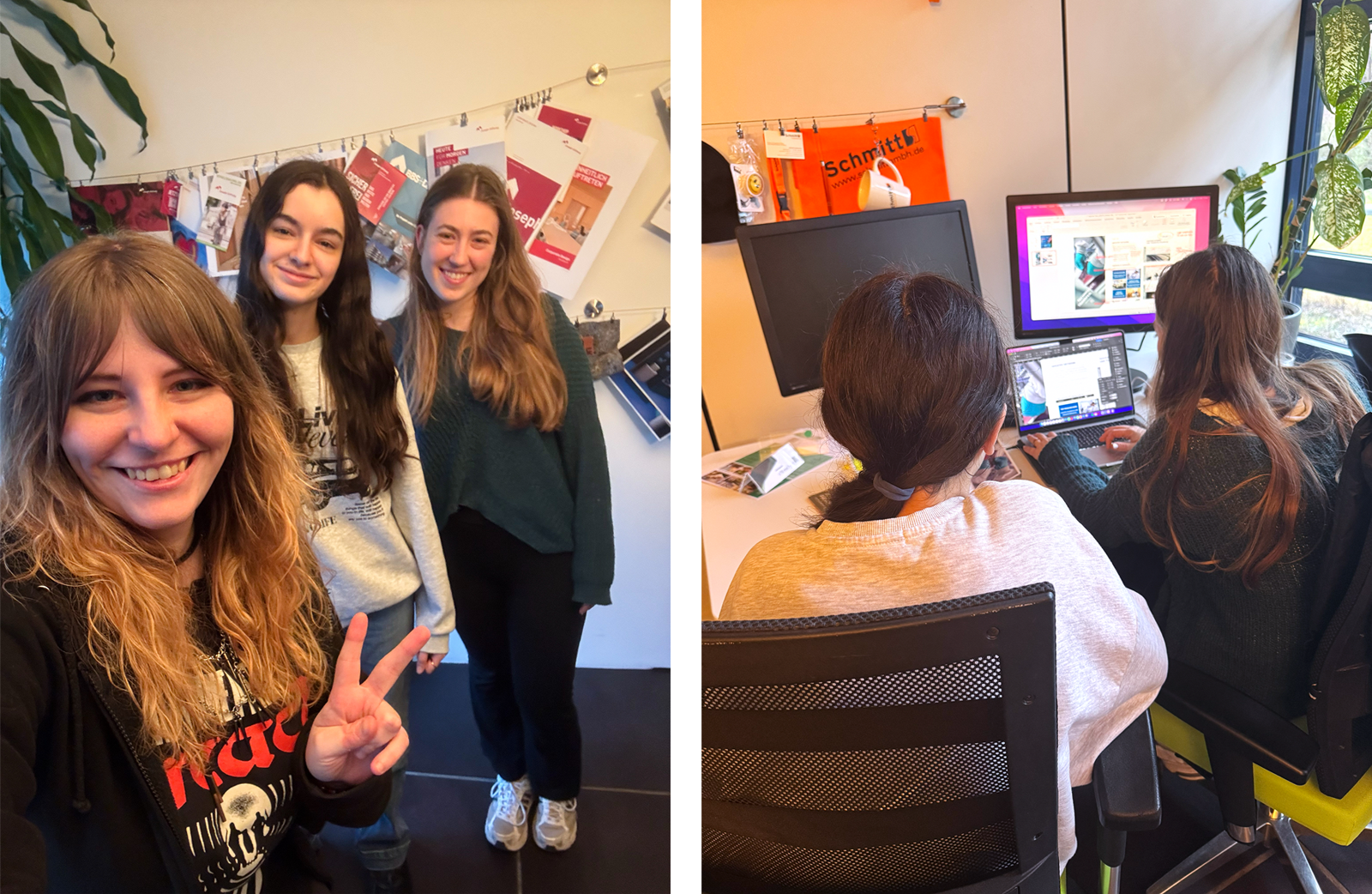
Hello 😊 I’m Jette and I’m in year 9 at Johannes Scharrer High School in Nuremberg. This year was something very special for me: my very first internship – and I was able to do it at 2be_die markenmacher! I was really excited to see what awaited me in a marketing and branding agency. And I can already say that it was much more varied than I had imagined.

I was able to get a taste of design right at the beginning. Together with Kati and Hanna, I learned how important colors, fonts and images are – and that there is a lot of planning behind a seemingly “simple” flyer.

My highlight:

I was allowed to design my own flyer! From the idea to the layout to the finished design – I got to see step by step how something like this is created. I’m really proud of my result and am already looking forward to showing it to my family at home.

Another highlight was that Matthias took me to a customer meeting. There I was able to see how an initial prospect can become an employee. I found it particularly exciting to see how much planning, structure and good communication there is behind such a process.

Kati, Jette and Hanna

My conclusion

During my internship, I not only learned a lot of new things in the field of design, but also gained exciting insights into marketing and communication. I was able to experience real work processes and understand how an initial idea develops into a concrete project. I was particularly impressed by how creative, versatile and varied the work in a marketing agency is.

A big thank you to the entire team at 2be_die markenmacher for allowing me to have this experience – and for taking the time for me.

Your Jette

PS from 2be: Dear Jette, we were very pleased that you spent your internship week with us! 🙂 You really impressed us with your enthusiasm and self-confidence. We wish you continued success at school – and if you decide to take this path in a few years’ time, we will be happy to keep a place open for you at 2be.

Your 2be team

Marketing & sales: where does AI help with automation?

2 Min.

Every marketing and sales department has its own strengths – but also its own construction sites. There are often problems at the interfaces in particular: information does not flow smoothly, processes take too long or responsibilities are unclear. This is precisely where artificial intelligence (AI) can provide support and significantly simplify processes.

AI in marketing: smart automation of standard tasks

In collaboration with AI specialists (e.g. from Rabbit Hole), we have already developed numerous solutions that take care of routine tasks. In the social media sector in particular, it quickly becomes clear how much time can be saved:

  • AI creates initial text drafts that only need to be adapted.
  • Graphics, image ideas and postings can be prepared automatically.
  • AI can even take over the technical post to a large extent.
  • This saves resources and gives editors the opportunity to concentrate on creative and strategic tasks

Better collaboration: linking marketing & sales through AI

It gets exciting when AI not only takes over individual tasks, but also links marketing and sales more closely together. After all, a well-coordinated workflow increases productivity and efficiency in both areas.

Possible fields of application:

  • Creation of publications (print & digital)
  • Planning and organization of events, seminars or webinars
  • Automated coordination of campaigns between sales and marketing

Conclusion: AI as a team player in the company

AI is not an end in itself, but a tool for making internal processes smarter. Used correctly, it ensures that marketing and sales no longer work side by side, but together – more efficiently, more productively and with clearly noticeable added value.

Curious now?
Our contact persons will be happy to help:

Matthias Brinkmann
+49 911 47494949
brinkmann@twobe.de
LinkedIn
Efficiency meets emotion: how modern content marketing works

2 Min.

After years of intensive practice with AI tools in text, image and video, we know pretty well where artificial intelligence shines – and where it still needs fine-tuning. Our conclusion: It’s all in the mix!

Because when used correctly, AI not only saves time and costs – it also enables genuine quality with personality. And that is precisely the key: semi-automated use of AI, combined with a human eye for detail.

How it works for us – example social media

Let’s take social media: AI can prepare a lot here. From text and graphics to video clips – the tools provide a solid foundation in a flash.

But blindly accepting everything is dangerous and is often immediately noticeable, which is why our team comes into play: our editors, graphic designers and video professionals check, delete or edit – depending on the platform, target group and tonality. This is how good input becomes great content. What makes it special: We work closely with our partner Rabbit Hole Group and link man and machine at all editorial interfaces – whether online or offline. This ensures that the content ends up exactly where it is supposed to: precisely tailored, stylish and coordinated across all media.

More time for ideas – we take care of the rest

What does that mean for you? Quite simply, you get a well-coordinated team that can not only operate AI, but really use it. You save time, retain full control over the quality – and your content gets the finishing touches that only real professionals can deliver.

We provide you with teams of experts who let the AI do the routine work – and concentrate on what really counts: Style, emotion, understanding your target group. And all this in a workflow that works. We promise!

Curious now?
Our contact persons will be happy to help:

Matthias Brinkmann
+49 911 47494949
brinkmann@twobe.de
LinkedIn

Use newsletters as an information and sales channel!

2 Min.

E-mails are still one of the best ways to stay in touch with customers and partners. Just like analog mailboxes in the past, email inboxes have retained their special status in everyday digital life. The motto “the good ones in the pot, the bad ones in the bowl” also applies here: Spam ends up in the virtual wastepaper basket – easier than ever thanks to filters and blocking functions. But this is precisely where the opportunity lies: if you manage to attract the attention of your target group with relevant and appealing content, you can use emails and newsletters as an effective information and sales channel.

Why emails and newsletters are still unbeatable

Good old habits can be used wonderfully for modern marketing. Sending emails – be it for the latest news, company updates or product information – is a tried and tested method that never goes out of fashion. Regular newsletters are particularly popular and effective. The important thing is that the content counts. And doubly so! On the one hand, it must be interesting for your target group, and on the other, it should be clear, concise and, above all, useful. Nobody wants to end up in the spam folder – and certainly not with valuable information that will never be read.

How to design newsletters that are well received

  1. Relevance is the key: only send content that really matters to your readers. Whether general added value or individually tailored tips – your subscribers should always feel addressed.
  2. Get to the point: Lengthy texts are off-putting. Short, crisp and with a recognizable benefit for the reader – that’s how your message convinces.
  3. A good first impression: The subject and the first few lines of an e-mail often decide whether it is opened. Make sure they arouse curiosity!

Our conclusion: emails and newsletters remain relevant

Regardless of whether you want to acquire new customers or maintain existing partnerships: Emails are still an extremely valuable communication channel. We recently tried it out ourselves when we sent out a new newsletter – and we were delighted with the positive feedback! Take advantage of this potential to spread your messages in a simple, effective and appealing way. Your mailbox (and that of your customers) can be more than just a collection point for digital mail!

Curious now?
Our contact persons will be pleased to help you:

Matthias Brinkmann

+49 (0)911 / 47 49 49 49
brinkmann@twobe.de